Events
The Science of Sharpness: How Manufacturers Quantify the Perfect Edge
News 2026-03-10 2,508
In the precision manufacturing industry—for high-end culinary tools, surgical scalpels, or industrial cutters—"sharp" is no longer a subjective feeling; it is a measurable data point. To maintain quality and brand reputation, industry leaders have moved beyond traditional "paper slice" tests toward quantifiable, scientific standards.
This guide explores the industrial standards and cutting-edge technologies used to define the world’s sharpest edges.
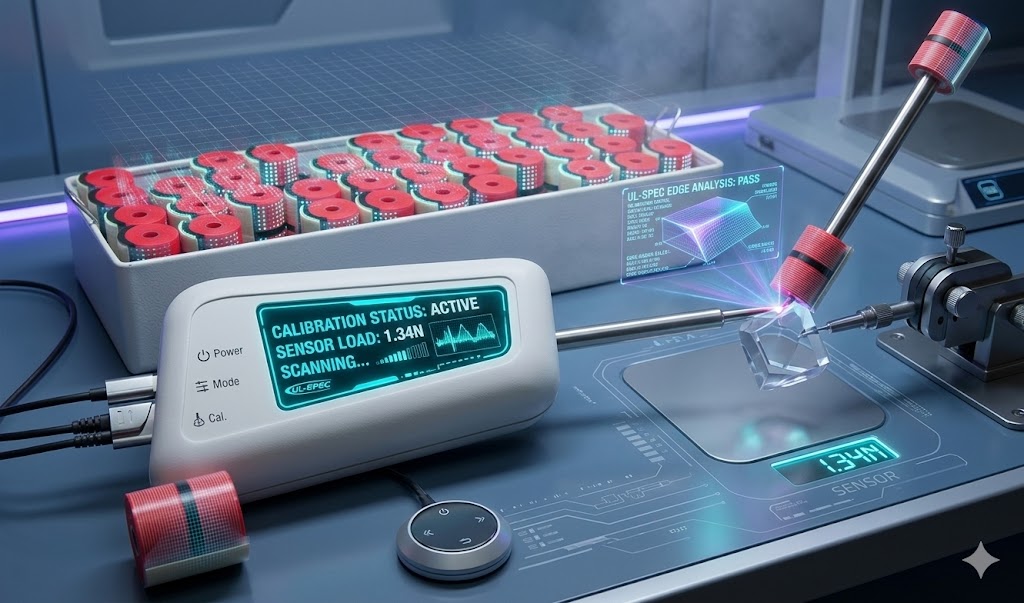
Sharpest Edge
1. The Gold Standard: CATRA Testing (ISO 8442-5)
The Cutlery and Allied Trades Research Association (CATRA) developed the most recognized machine-based test in the industry, forming the basis of the ISO 8442-5 standard.
- The Mechanism: A machine holds a blade vertically and strokes it against specialized synthetic paper containing 5% silica.
- Initial Cutting Performance (ICP): This measures the depth of the cut during the first three strokes, representing "out-of-the-box" sharpness.
- Total Card Cut (TCC): This measures cumulative depth over 60+ strokes to quantify edge retention—how long the blade actually stays sharp.
2. The BESS Scale: Measuring Force in Grams
The Brubacher Edge Sharpness Scale (BESS) is the preferred method for custom knifemakers and labs requiring high precision. Unlike CATRA, it measures the physical force required to sever a medium.
- The Process: A blade is pressed onto a certified synthetic filament, and a sensor records the peak force in grams at the moment of failure.
BESS Reference Chart:
| Score (Grams) | Sharpness Level | Typical Example |
| 0 - 50 | Extreme | High-end Double Edge Razors |
| 50 - 150 | Utility Razor | Professional Chef Knife |
| 200 - 300 | Very Sharp | New High-End Pocket Knife |
| 400 - 600 | Working Edge | Standard Kitchen Knife |
| 2000+ | Dull | Butter Knife |
3. Optical Inspection and Nanotechnology
For ultra-precision edges like surgical scalpels, physical contact tests can damage the edge. Manufacturers utilize non-destructive optical methods instead.
- Laser Goniometers: These devices use laser reflections to calculate exact edge anglesand detect microscopic burrs invisible to the eye.
- Scanning Electron Microscopy (SEM): Used to inspect the Apex Radius; a truly sharp blade has an apex thickness measured in nanometers.
FAQ: Frequently Asked Questions
Q: Is a lower BESS score better? A: Yes. Because BESS measures the force (in grams) required to cut a filament, a lower number means less force was needed, indicating a sharper edge.
Q: What is the difference between ICP and TCC?
A: ICP measures initial sharpness ("out-of-the-box"), while TCC measures the total life of the edge (edge retention).
Q: Why use Laser Goniometers instead of BESS?
A: Lasers provide a non-destructive way to check the geometry and angle of a blade without the physical contact that could dull a high-precision edge like a razor or scalpel.
Q: What is a "Working Edge"?
A: According to the BESS scale, a "Working Edge" (400–600g) is typical for a standard kitchen knife—sharp enough for daily tasks but not as refined as a professional chef's tool.
Would you like me to generate a technical comparison table between different steel types (like S30V vs. M390) and how they typically perform in these sharpness tests?
Related articles
- Why Liquid Ingress Protection Test Chambers Are Essential
- ISO594: A Comprehensive Overview and Its Relevance to Industry
- Why Concora CMT Supplier Stands Out
- Corrugated Box Compression Testing Machines: The Ultimate Guide
- Essentials of Motor Testing Equipment
- The Essential Guide to UV Climate Resistant Aging Chambers
- Enhancing Radiological Diagnostic Test Solutions
- Metal Luer Connector: Essential Components in Medical Devices